
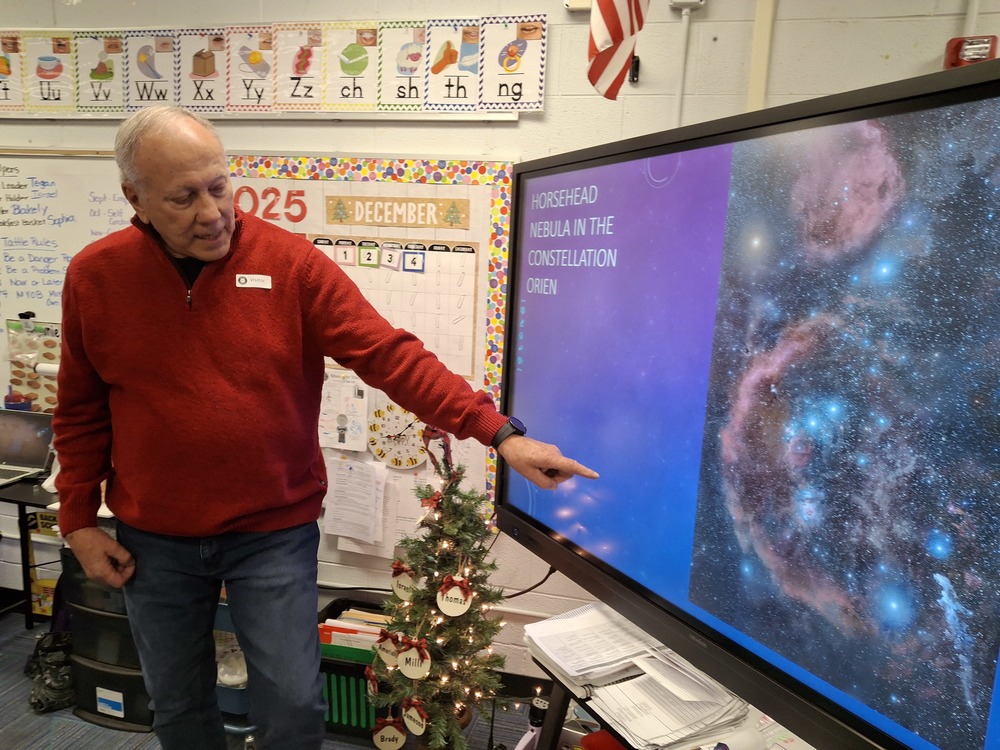
A Visit from an Astrophotographer: Ed Litoborski Inspires Young Astronomers
Submitted by Heather Layton, BES Teacher
Ed Litoborski, an astrophotographer and amateur astronomer from Anderson, South Carolina, visited Brevard Elementary School to celebrate the first graders’ CKLA unit on astronomy. He brought amazing photos of the solar system and deep-space objects. The students were excited to see how many stars fill a galaxy and learned about clouds of gas called nebulae, including the bright, colorful Christmas Tree Nebula.
A universe of questions
While looking at Ed’s photos, the first graders asked big questions: “Why do stars explode?” “Do you know what a supernova is?” and “Why are black holes so creepy?” These questions show how curious students are about space. Ed used simple ideas and pictures to help them understand these huge ideas.
What students learned
Ed’s visit showed students that curiosity and practice can turn wonder into a new skill, or even a new career, later in life. By seeing real photos and hearing how those photos are made, students learned that science, technology, art and creativity can go together. Ed encouraged the young learners to keep asking questions and to try exploring the sky themselves.
Astrophotography is more than pointing a camera at the sky. First, you choose the right telescope and camera for what you want to photograph. Planets need different equipment than galaxies or nebulae. The telescope must be aligned carefully so it can follow the movement of the sky as Earth turns. Many astrophotographers use computerized mounts that track stars and planets so images don’t become blurry. Photographers often use long exposures, which means keeping the camera open for a long time to collect faint light. Long exposures can show details that are invisible to the eye. After taking pictures, there is an important step called post-processing. This is when photographers use special software to adjust brightness and color, remove unwanted spots (noise), and reveal hidden structures in the image. Each part of the process—planning, taking pictures, and editing—requires patience, practice and learning from mistakes.
How Ed became an astrophotographer
Ed’s interest in space started when he was young. His love for astronomy grew stronger after he saw Saturn’s rings and Jupiter’s moons through telescopes at PARI during a visit with his stepdaughter, a teacher at Brevard Elementary School. As he prepared for retirement, Ed decided to learn how to take pictures of the night sky. He practiced both the science (how stars and planets move and shine) and the art (how to make beautiful images). Now, he is sharing his knowledge with students!